
By Chris Cooke (Hoedspruit Reptile Centre)
Few animals command the same mixture of respect, fear and fascination as the Nile crocodile (Crocodylus niloticus). This formidable reptile occurs across much of sub-Saharan Africa and, in South Africa, is associated mainly with the warm rivers, lakes, dams and estuaries of KwaZulu-Natal, Mpumalanga and Limpopo.
Adult Nile crocodiles have broad, heavily armoured bodies, powerful tails and long jaws lined with conical teeth. Their rough, olive-brown skin provides excellent camouflage, while rows of raised bony scutes offer armoured protection. Males grow considerably larger than females, and exceptional individuals may exceed five metres in length. Their eyes, ears and nostrils are positioned on top of the head, allowing almost the entire body to remain concealed beneath the water. Despite their bulky form, crocodiles move with surprising speed over short distances on land and are exceptionally agile in their aquatic environment.
Nile crocodiles are opportunistic generalist predators. Hatchlings feed mainly on arthropods, amphibians and small fish, while larger animals take bigger fish, birds, reptiles and mammals. Adults may ambush a variety of antelope and other animals drinking at the water’s edge, but they also scavenge carrion and help remove dead animals from aquatic systems. Their powerful jaws grip prey, while the muscular tail provides the explosive acceleration through the water to set the ambush.
Breeding occurs seasonally. A female excavates a nest chamber in sandy banks above the waterline and may lay several dozen hard-shelled eggs. She guards the nest throughout incubation and responds to the calls of hatchlings when they are ready to emerge. The mother gently carries the young to water in her mouth and remains close to them during their vulnerable early lives. The temperature of the nest influences the sex of the developing embryos, not their chromosomes, making suitable nesting sites especially important.
The Nile crocodile possesses several remarkable adaptations. A transparent third eyelid protects the eye underwater, while a muscular palatal valve, the gular flap, closes the throat when the mouth is open beneath the surface. Crocodiles can remain submerged for extended periods by slowing their heart rate and redirecting blood flow. Sensitive pressure receptors around the jaws called Integumentary Sensory Organs, detect tiny movements and other valuable information in the water, enabling accurate hunting even in poor visibility.
Although the species is globally widespread, South Africa’s Nile crocodile population is regionally classified as Vulnerable. Major threats include the loss and degradation of wetlands and river systems, dam construction, pollution and declining fish stocks. Crocodile fat is also collected for the muti market trade. In recent years, the long term accumulation of lead in important water bodies has caused deaths and disabilities in specific costal populations and a mass die-off event has also been reported in the Kruger National Park.
People remain one of the species’ most serious threats. Crocodiles are sometimes deliberately killed because they are feared, blamed for livestock losses or considered dangerous after attacks on people. Others are persecuted for meat, skins or traditional medicine. Protecting crocodiles therefore requires healthy river systems, effective law enforcement and practical education that helps communities reduce conflict. As apex predators and scavengers, Nile crocodiles remain vital participants in the functioning of aquatic ecosystems that support extraordinary biological diversity.
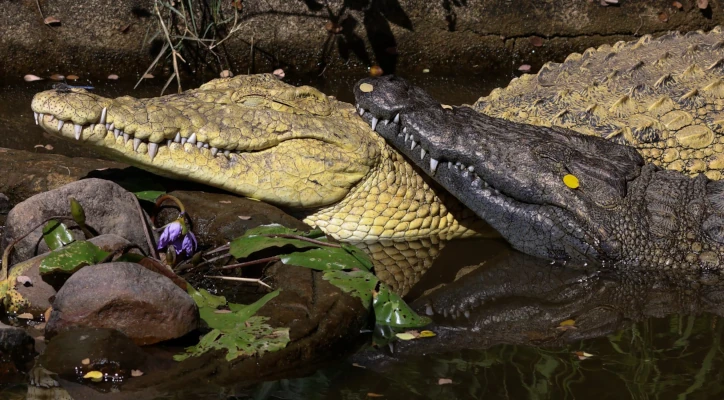
At Hoedspruit Reptile Centre, we have two Nile crocodiles that are approximately 20 years old. Albie, has a genetic abnormality called amelanism, partial lack of melanin pigments. This is what gives Albie his yellow appearance, and is different from true albinism in that he does not have the characteristic “red eyes”.
Albie arrived at HRC as a yearling, in a cardboard box which had been dumped at the Centre reception, after appearing briefly in a movie- or so the story goes. None of our team that are currently working at the centre were around back then and so we are unable to verify this. Albie is super smart, and very cunning. Our other beloved Nile croc is Odile. She is the more shy of the two. She has a lovely personality and is super sweet, most of the time. She can also be super stubborn ,and will not leave her pond for cleaning unless it is convenient for her. She came to HRC from a crocodile farm in 2021, and we are proud to say she won’t become a handbag, a belt, or a burger any longer.
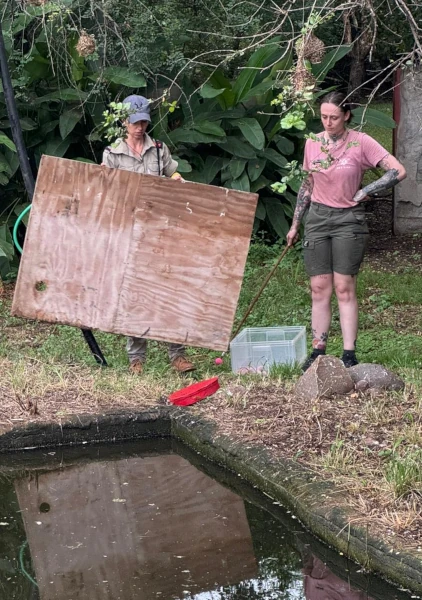
We have recently started the process of training our crocodiles at HRC. The purpose of this is to provide environmental, physical and mental stimulation as well as to conditional the crocodiles to be more “keeper friendly”. Captive crocodiles can easily learn feeding behaviour and become very food motivated. They can recognise keeper uniforms and voices, as well as objects like brooms, food buckets, and feeding tongs. A bad situation to be in, is to be charged by a highly food driven crocodile that may accidentally mistake a keeper for it it’s meal. One of the co-objectives of training the crocodiles is to manage this high food motivated behaviour. The focus of our efforts will be to encourage our scaly friends to calmly approach keepers when individually called, to stop in front of them and to patiently wait for their meal reward. No rushing, no excited behaviours.
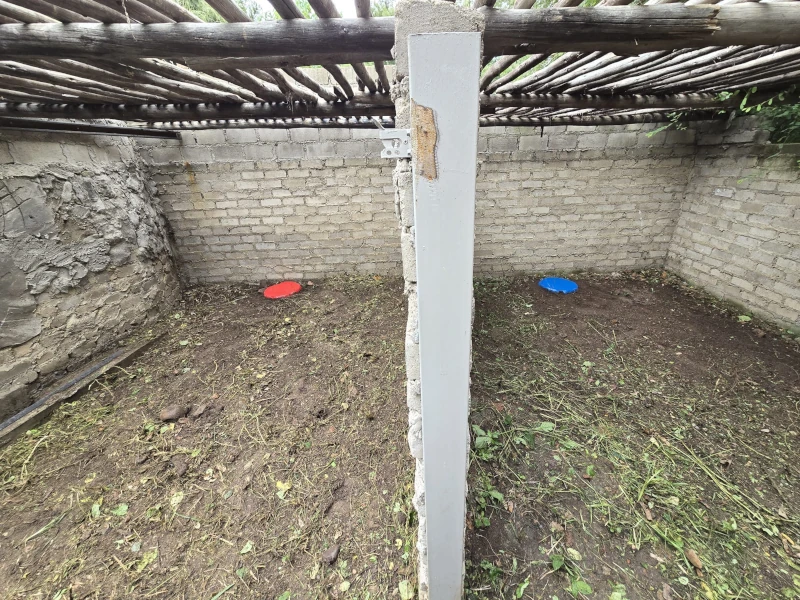
In additional to training we have made another important safety modification- the creation of a lockable night room. Whilst in most instances it’s perfectly okay to conduct enclosure maintenance with a crocodile still in its habitat, one very real critical risk exists. If you accidentally fall into the pond, chances are you won’t get out before the crocs get in.

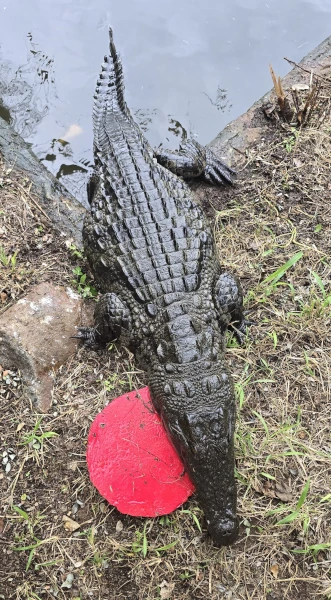

To eliminate this, our crocs are trained to move into their night rooms on command and to station onto a target (a colourful concrete block). The night room doors are then closed and locked, allowing keepers to freely move around the enclosure and go about their business.
Its easy to fall into the trap of thinking crocs are prehistoric mindless predators, especially because most of us find it hard to understand their behaviour cues. They simply don’t have the emotive facial expressions we are so used to reading that one sees in mammals and birds. Crocodiles are highly intelligent, adaptable and patient and for crocodiles in captivity to be truly happy , they need regular enrichment. Challenge yourselves and your animals and do share your experiences.